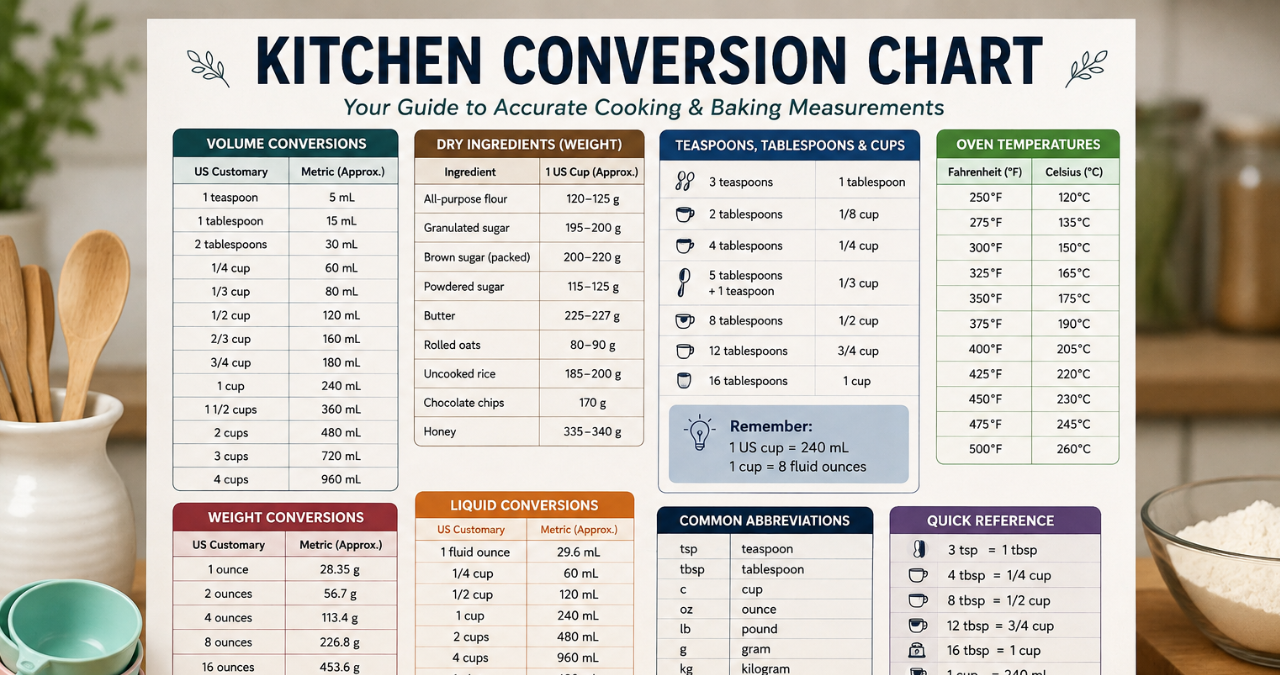

Kitchen conversion chart is one of the most useful tools a home cook or baker can keep nearby. Whether you’re following a recipe from another country, changing a recipe for a larger family, or trying to understand the difference between cups, tablespoons, grams, and milliliters, a reliable conversion guide can make cooking much easier.
Recipes often use different measurement systems. A recipe from the United States may use cups and tablespoons, while a recipe from the United Kingdom, Australia, or another country may use grams and milliliters. At first glance, these differences can seem confusing. Luckily, once you understand the basic relationships between measurements, converting recipes becomes much simpler.
A good kitchen conversion chart doesn’t just save time. It can also help improve accuracy, reduce waste, and make unfamiliar recipes easier to follow. From measuring flour and sugar to converting oven temperatures and liquid quantities, this guide covers the essential information every home cook should know.
Why a Kitchen Conversion Chart Is Important
Cooking is both an art and a science. You can sometimes add a little extra seasoning or adjust a sauce by taste, but measurements matter greatly in many recipes, especially baking.
Imagine finding a wonderful cake recipe that calls for 350 grams of flour, but your measuring tools are marked only in cups. Without a conversion guide, you may have to stop cooking and search for an answer. A handy chart puts the information right at your fingertips.
A conversion chart is particularly useful for:
- Converting metric measurements to U.S. measurements
- Converting U.S. measurements to metric measurements
- Understanding tablespoons and teaspoons
- Measuring liquids accurately
- Converting oven temperatures
- Adjusting recipes for different serving sizes
- Understanding common cooking abbreviations
- Comparing ingredient weights and volumes
- Following recipes published in different countries
In short, it takes the guesswork out of everyday kitchen measurements.
Understanding the Main Kitchen Measurement Systems
Before using a conversion chart, it’s helpful to understand the two major systems you’ll encounter in recipes.
Metric Measurements
The metric system is widely used around the world. It is based on units such as:
- Grams (g) for weight
- Kilograms (kg) for larger weights
- Milliliters (mL) for liquid volume
- Liters (L) for larger liquid quantities
- Degrees Celsius (°C) for temperature
The metric system is convenient because it works with simple factors of 10. For example, 1 kilogram equals 1,000 grams, while 1 liter equals 1,000 milliliters.
U.S. Customary Measurements
Many American recipes use measurements such as:
- Teaspoons
- Tablespoons
- Fluid ounces
- Cups
- Pints
- Quarts
- Gallons
- Ounces and pounds for weight
These measurements don’t always follow a simple decimal system, so a chart can be particularly helpful.
Kitchen Conversion Chart for Common Volume Measurements
The following chart provides useful approximate conversions for common kitchen volume measurements. These values are especially helpful when working with liquids.
| U.S. Measurement | Approximate Metric Equivalent |
|---|---|
| 1 teaspoon | 5 mL |
| 1 tablespoon | 15 mL |
| 2 tablespoons | 30 mL |
| ¼ cup | 60 mL |
| ⅓ cup | 80 mL |
| ½ cup | 120 mL |
| ⅔ cup | 160 mL |
| ¾ cup | 180 mL |
| 1 cup | 240 mL |
| 1½ cups | 360 mL |
| 2 cups | 480 mL |
| 3 cups | 720 mL |
| 4 cups | 960 mL |
These numbers are rounded for practical kitchen use. In professional baking or scientific work, more precise measurements may sometimes be preferred.
One important point is that volume and weight aren’t the same thing. A cup measures space, while grams measure mass. This distinction becomes extremely important when measuring dry ingredients.
Kitchen Conversion Chart for Teaspoons, Tablespoons, and Cups
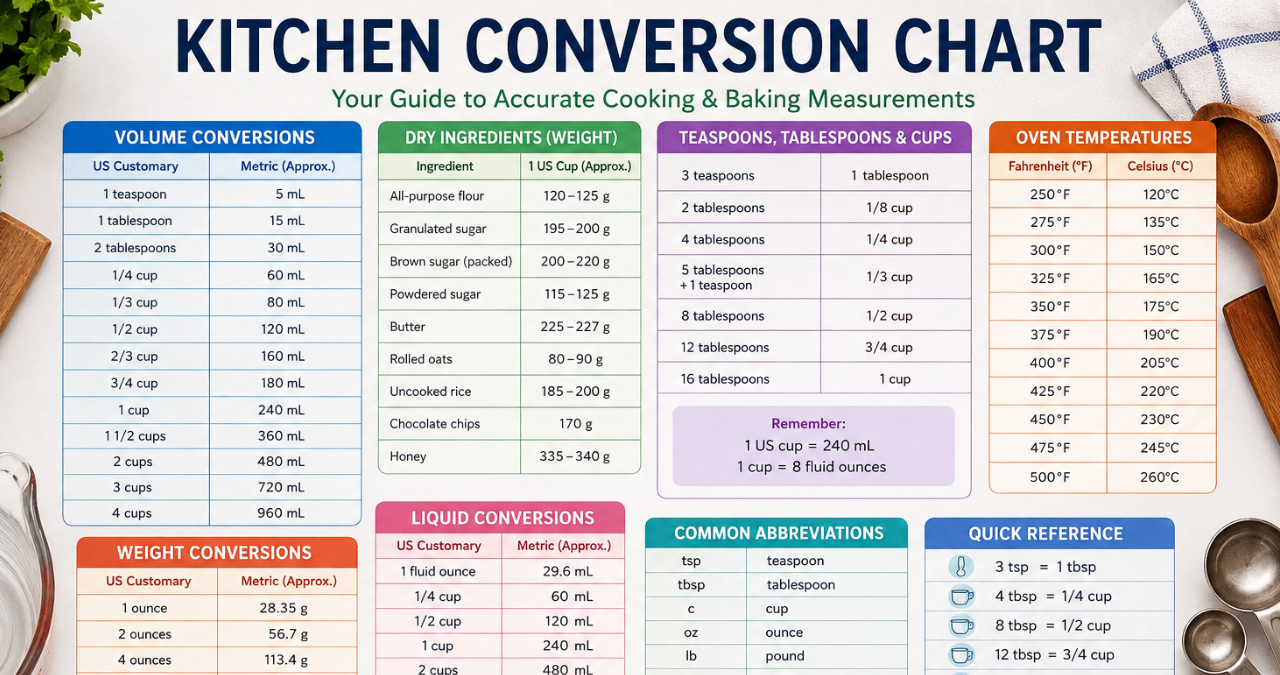
Kitchen conversion chart Small measurements appear in almost every recipe. A simple relationship to remember is:
- 3 teaspoons = 1 tablespoon
- 16 tablespoons = 1 U.S. cup
- 1 U.S. cup = 8 U.S. fluid ounces
- ½ cup = 8 tablespoons
- ¼ cup = 4 tablespoons
- ⅓ cup = approximately 5 tablespoons + 1 teaspoon
- ¾ cup = 12 tablespoons
These conversions are useful when you don’t have a particular measuring spoon or cup available.
For example, if a recipe asks for ¼ cup of oil but you only have a tablespoon measure, you can use 4 tablespoons.
Dry Ingredients: Why Grams Can Be Better Than Cups
Dry ingredients create one of the biggest challenges in recipe conversion.
A cup of flour does not have the same weight as a cup of sugar. Even two cups of the same ingredient can have different weights depending on how the ingredient is packed.
For example, flour can become more compact when pressed into a measuring cup. If you scoop it directly from a bag, you may accidentally add more flour than the recipe intended.
This is why many professional bakers prefer using a kitchen scale.
Here are approximate examples:
| Ingredient | Approximate Weight of 1 U.S. Cup |
|---|---|
| All-purpose flour | 120–125 g |
| Granulated sugar | 195–200 g |
| Brown sugar, packed | 200–220 g |
| Powdered sugar | 115–125 g |
| Butter | 225–227 g |
| Rolled oats | 80–90 g |
| Uncooked rice | 185–200 g |
| Chocolate chips | 170 g |
| Honey | 335–340 g |
These figures are approximate because ingredient density, packing, brand, and measuring technique can affect the result.
So, if a recipe gives a weight measurement, it’s generally best to use a kitchen scale rather than trying to convert everything into cups.
Liquid Measurement Conversions
Liquids are generally easier to convert because their volume can be measured consistently.
Common kitchen liquids include:
- Water
- Milk
- Cream
- Cooking oil
- Vinegar
- Juice
- Syrups
For practical cooking, you can remember:
1 U.S. cup ≈ 240 mL
This means:
- ½ cup ≈ 120 mL
- ¼ cup ≈ 60 mL
- ⅓ cup ≈ 80 mL
- ¾ cup ≈ 180 mL
- 2 cups ≈ 480 mL
- 4 cups ≈ 960 mL
When a recipe uses milliliters, using a liquid measuring jug is often the easiest approach.
Kitchen Conversion Chart for Weight
Weight measurements are especially common in baking and recipes from countries that use the metric system.
| U.S. Weight | Metric Equivalent |
|---|---|
| 1 ounce | 28.35 g |
| 2 ounces | 56.7 g |
| 4 ounces | 113.4 g |
| 8 ounces | 226.8 g |
| 16 ounces | 453.6 g |
| 1 pound | 453.6 g |
| 2 pounds | 907.2 g |
| 1 kilogram | 2.2 pounds |
For everyday cooking, you can usually round 1 ounce to about 28 grams and 1 pound to about 454 grams.
However, remember that ounces can refer to either weight or fluid volume, depending on the context. A fluid ounce measures liquid volume, while a regular ounce measures weight.
That’s an easy detail to overlook, but it can make a big difference.
Cups to Grams: Why There Isn’t One Universal Answer
One of the most common cooking questions is, “How many grams are in a cup?”
Unfortunately, there isn’t a single answer.
The reason is simple: different ingredients have different densities.
For example:
- A cup of flour weighs much less than a cup of honey.
- A cup of sugar weighs more than a cup of many lightweight dry ingredients.
- A cup of chopped nuts can have a different weight from a cup of whole nuts.
- A cup of packed brown sugar weighs differently from a cup of loosely measured brown sugar.
Therefore, it’s better to use an ingredient-specific conversion.
Approximate Cup-to-Gram Examples
| Ingredient | 1 Cup Approximate Weight |
|---|---|
| All-purpose flour | 120–125 g |
| Granulated sugar | 195–200 g |
| Butter | 227 g |
| Honey | 335–340 g |
| Cocoa powder | 85–90 g |
| Rolled oats | 80–90 g |
| Chopped nuts | 110–130 g |
| Cooked rice | 180–200 g |
| Breadcrumbs | 100–120 g |
These figures should be treated as practical estimates rather than absolute measurements.
Kitchen Conversion Chart for Oven Temperatures
Temperature conversions are another important part of cooking.
Recipes may give oven temperatures in Fahrenheit or Celsius. Here’s a useful reference:
| Fahrenheit | Celsius Approx. |
|---|---|
| 250°F | 120°C |
| 275°F | 135°C |
| 300°F | 150°C |
| 325°F | 165°C |
| 350°F | 175°C |
| 375°F | 190°C |
| 400°F | 205°C |
| 425°F | 220°C |
| 450°F | 230°C |
| 475°F | 245°C |
| 500°F | 260°C |
For example, a recipe calling for 350°F can generally be set to about 175°C.
Keep in mind that ovens vary. Some ovens run hotter or cooler than the displayed temperature, so an oven thermometer can be useful when precise baking results matter.
Common Cooking Abbreviations
Recipes often save space by using abbreviations. Understanding them can prevent mistakes.
| Abbreviation | Meaning |
|---|---|
| tsp | teaspoon |
| tbsp | tablespoon |
| c | cup |
| oz | ounce |
| lb | pound |
| g | gram |
| kg | kilogram |
| mL | milliliter |
| L | liter |
| °F | degrees Fahrenheit |
| °C | degrees Celsius |
Pay close attention to tsp and tbsp. They aren’t interchangeable. Three teaspoons equal one tablespoon, so using a tablespoon when a recipe asks for a teaspoon could add three times the intended amount.
Measuring Ingredients Correctly
A conversion chart is useful, but proper measuring technique matters just as much.
Measuring Flour
For flour, many cooks use the spoon-and-level method:
- Fluff the flour gently.
- Spoon it into the measuring cup.
- Avoid packing it down.
- Level the top with a straight edge.
This technique helps prevent adding too much flour.
Measuring Brown Sugar
Brown sugar is commonly packed into the measuring cup when the recipe specifically says “packed.”
Press the sugar into the cup until it holds its shape when removed.
Measuring Liquids
For liquids, use a transparent liquid measuring cup.
Place the cup on a flat surface and read the measurement at eye level. This is more accurate than holding the cup in the air and trying to judge the level from above.
Measuring Small Quantities
Use measuring spoons for:
- Salt
- Baking powder
- Baking soda
- Spices
- Extracts
- Small amounts of oil
- Other small ingredients
Level the spoon unless the recipe specifically says “heaping.”
Kitchen Conversion Chart for Recipe Scaling
Sometimes you don’t want to convert units—you want to change the recipe size.
Suppose a recipe serves 4 people but you want to serve 8. You can double every ingredient.
For example:
| Original | Doubled |
|---|---|
| 1 cup | 2 cups |
| ½ cup | 1 cup |
| ¼ cup | ½ cup |
| 1 tablespoon | 2 tablespoons |
| 1 teaspoon | 2 teaspoons |
| 2 eggs | 4 eggs |
If you want to make half the recipe, divide each ingredient by two.
Recipe scaling becomes slightly more complicated with ingredients such as eggs. If you need half of 1 egg, beat the egg thoroughly and measure approximately half of it rather than guessing.
Metric and U.S. Cups Are Not Always Identical
This is an important detail for international cooking.
A U.S. customary cup is approximately 236.6 mL, while many recipe charts round it to 240 mL for convenience.
Some countries use a metric cup of 250 mL. Australia, for example, commonly uses a 250 mL cup in recipes.
That means a recipe’s “1 cup” isn’t necessarily identical everywhere.
For most everyday recipes, the difference may not cause a noticeable problem. However, when precision matters—especially in baking—it’s wise to check which measurement system the original recipe uses.
Kitchen Conversion Chart for Quick Reference
Here is a compact reference you can save or print.
| Measurement | Approximate Conversion |
|---|---|
| 1 tsp | 5 mL |
| 1 tbsp | 15 mL |
| 3 tsp | 1 tbsp |
| 4 tbsp | ¼ cup |
| 8 tbsp | ½ cup |
| 12 tbsp | ¾ cup |
| 16 tbsp | 1 cup |
| 1 cup | 240 mL |
| 1 fluid oz | 29.6 mL |
| 1 oz weight | 28.35 g |
| 1 lb | 453.6 g |
| 1 kg | 1,000 g |
| 1 L | 1,000 mL |
| 350°F | 175°C |
| 400°F | 205°C |
| 450°F | 230°C |
Keep in mind that rounded conversions are intended for practical cooking rather than laboratory-level precision.
Common Kitchen Conversion Mistakes to Avoid
Even experienced cooks can make measurement mistakes from time to time. Fortunately, most are easy to prevent.
Confusing Weight With Volume
Don’t assume that 1 cup always equals a particular number of grams. The answer depends on the ingredient.
Confusing Fluid Ounces With Ounces
Fluid ounces measure volume. Ounces measure weight. They are related but aren’t the same type of measurement.
Packing Ingredients That Should Be Loose
Flour, cocoa powder, and similar ingredients shouldn’t normally be pressed into a dry measuring cup unless the recipe says otherwise.
Using a Tablespoon Instead of a Teaspoon
This is a classic kitchen slip-up. Always check the abbreviation before measuring.
Forgetting Recipe Temperature Differences
If a recipe uses Celsius and your oven uses Fahrenheit, convert the temperature before starting.
Relying on Rough Estimates for Baking
A pinch of this or a splash of that may work beautifully for soup, but baking often requires greater accuracy.
How a Kitchen Scale Can Improve Accuracy
A digital kitchen scale is one of the best tools for anyone who bakes regularly.
Instead of measuring flour with a cup, you can weigh the exact number of grams specified in the recipe.
This has several advantages:
- Better consistency
- Less mess
- Fewer measuring cups to wash
- Easier recipe scaling
- More accurate baking
- Better results when following international recipes
For example, if a recipe calls for 300 grams of flour, weighing 300 grams is much more straightforward than trying to determine exactly how many cups that represents.
When You Should Use a Conversion Chart
A conversion chart is particularly helpful when:
- A recipe uses unfamiliar units.
- You’re cooking from an international cookbook.
- Your measuring equipment uses different units.
- You’re scaling a recipe.
- You’re converting Fahrenheit to Celsius.
- You’re converting ounces to grams.
- You’re trying to understand a recipe written for another country.
- You’re preparing a recipe where accurate measurements matter.
It’s one of those simple kitchen references that can save you from stopping halfway through a recipe to search for every individual conversion.
Tips for Getting Consistent Cooking Results
Measurements are only one part of successful cooking. A few additional habits can make your results more reliable.
Read the Whole Recipe First
Before measuring anything, read the recipe from beginning to end. This helps you understand the required ingredients, temperatures, cooking times, and equipment.
Prepare Ingredients Before Cooking
Gather everything you need before starting. This is sometimes called “mise en place,” a French culinary phrase meaning to put everything in place.
Use the Right Measuring Tool
Use dry measuring cups for dry ingredients and liquid measuring cups for liquids when appropriate.
Check the Recipe’s Country of Origin
If a recipe comes from another country, check whether its cups, ounces, or other units follow a different convention.
Don’t Guess When Accuracy Matters
If you’re unsure, check a reliable conversion rather than making a random estimate. A few seconds of checking can save an entire batch of food.
Kitchen Conversion Chart for Everyday Cooking Confidence
Cooking shouldn’t feel like a mathematics exam. With a good reference chart and a little practice, measurements become second nature.
Start by learning a few basic relationships:
- 3 teaspoons = 1 tablespoon
- 16 tablespoons = 1 U.S. cup
- 1 U.S. cup ≈ 240 mL
- 1 ounce ≈ 28.35 g
- 1 pound ≈ 454 g
- 1 kilogram = 1,000 g
- 1 liter = 1,000 mL
- 350°F ≈ 175°C
Once these become familiar, many recipes will be much easier to understand.
Frequently Asked Questions About Kitchen Conversion Chart
How many tablespoons are in a cup?
There are 16 tablespoons in a U.S. cup.
How many teaspoons are in a tablespoon?
There are 3 teaspoons in a U.S. tablespoon.
How many milliliters are in a cup?
A U.S. customary cup is approximately 237 mL, and it is commonly rounded to 240 mL for everyday cooking.
How many grams are in one cup?
It depends on the ingredient. A cup of flour weighs much less than a cup of honey, for example. Ingredient-specific conversions are therefore more accurate.
How many grams are in a pound?
One pound equals approximately 453.6 grams, commonly rounded to 454 grams.
Is a fluid ounce the same as an ounce?
No. A fluid ounce measures volume, while an ounce commonly refers to weight.
What is 350°F in Celsius?
350°F is approximately 175°C.
Should I use cups or grams for baking?
When a recipe provides grams, using grams with a digital kitchen scale is usually the more consistent option.
Can I use the same conversion for every ingredient?
Not for weight-to-volume conversions. Different ingredients have different densities, so one cup can have very different weights depending on the ingredient.
Final Thoughts on Kitchen Conversion Chart
A dependable kitchen conversion chart can turn confusing measurements into simple, manageable information. Whether you’re preparing a quick family dinner, experimenting with an international recipe, or baking a delicate cake, knowing how to move between cups, spoons, grams, ounces, milliliters, and temperatures gives you greater confidence in the kitchen.
The most important lesson is to understand the difference between volume and weight. Cups, tablespoons, teaspoons, and milliliters measure volume, while grams, kilograms, ounces, and pounds generally measure weight. When accuracy is especially important, a digital kitchen scale is often the best choice.
Don’t worry if you can’t memorize every conversion overnight. Keep a kitchen conversion chart somewhere convenient, learn the most common measurements first, and use the chart whenever you need a quick answer. Before long, these conversions will become familiar, and you’ll be able to approach recipes from almost anywhere with confidence, accuracy, and a positive can-do attitude.