
How many cups in a pound? This is a common question for home cooks, bakers, students, and anyone following a recipe. At first, the answer may seem simple, but there isn’t always one exact number. The reason is that cups measure volume, while pounds measure weight. Different foods have different weights, so one pound of flour won’t take up the same number of cups as one pound of sugar, butter, rice, or chopped vegetables.
Understanding this difference can make cooking much easier. Whether you’re preparing cookies, bread, soup, a family dinner, or a special dessert, knowing how to convert pounds into cups can help you follow recipes with confidence.
In this complete guide, we’ll explain how many cups in a pound, why the answer changes from food to food, how to make accurate conversions, and which measuring method works best in different situations.
What Does a Pound Mean in Cooking?
A pound is a unit of weight or mass commonly used in the United States and some other countries. In short, a pound tells you how heavy an ingredient is.
One pound is equal to:
- 16 ounces by weight
- Approximately 453.6 grams
- Approximately 0.454 kilograms
When a recipe says you need one pound of an ingredient, it’s usually talking about the ingredient’s weight.
For example:
- 1 pound of butter weighs 16 ounces.
- 1 pound of flour weighs 16 ounces.
- 1 pound of sugar weighs 16 ounces.
However, these ingredients don’t occupy the same amount of space in a measuring cup. That’s where things can get a little tricky.
What Does a Cup Mean in Cooking?
How Many Cups in a Pound A cup is mainly a volume measurement. It tells you how much space an ingredient takes up.
In the United States, a standard measuring cup contains:
- 8 fluid ounces of volume
- About 237 milliliters
It’s important to remember that fluid ounces and ounces by weight aren’t the same thing.
For example, a cup of water weighs about 8 ounces because water has a particular density. But a cup of flour weighs much less than 8 ounces.
So, if someone asks, “How many cups are in a pound?” the best answer is:
It depends on the ingredient.
That’s the key point to remember.
How Many Cups in a Pound? The Basic Answer
There is no universal cup-to-pound conversion for every ingredient.
A pound measures weight, while a cup measures volume. Since foods have different densities, one pound can equal different numbers of cups.
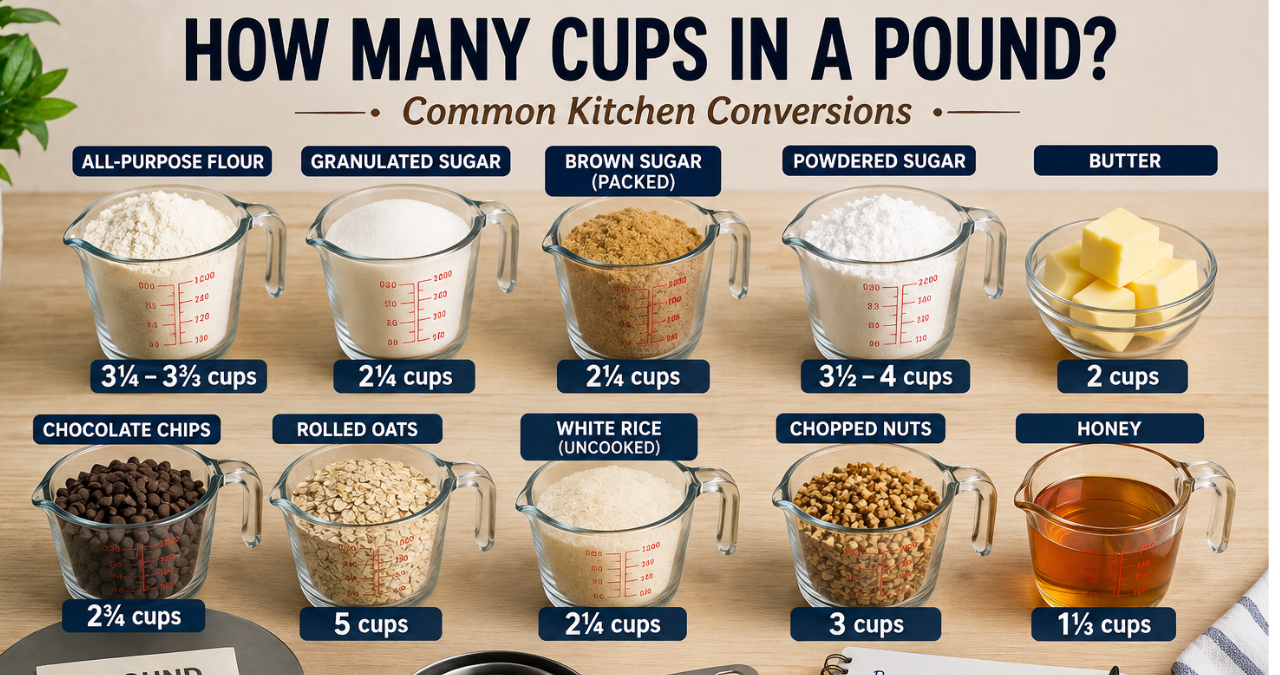
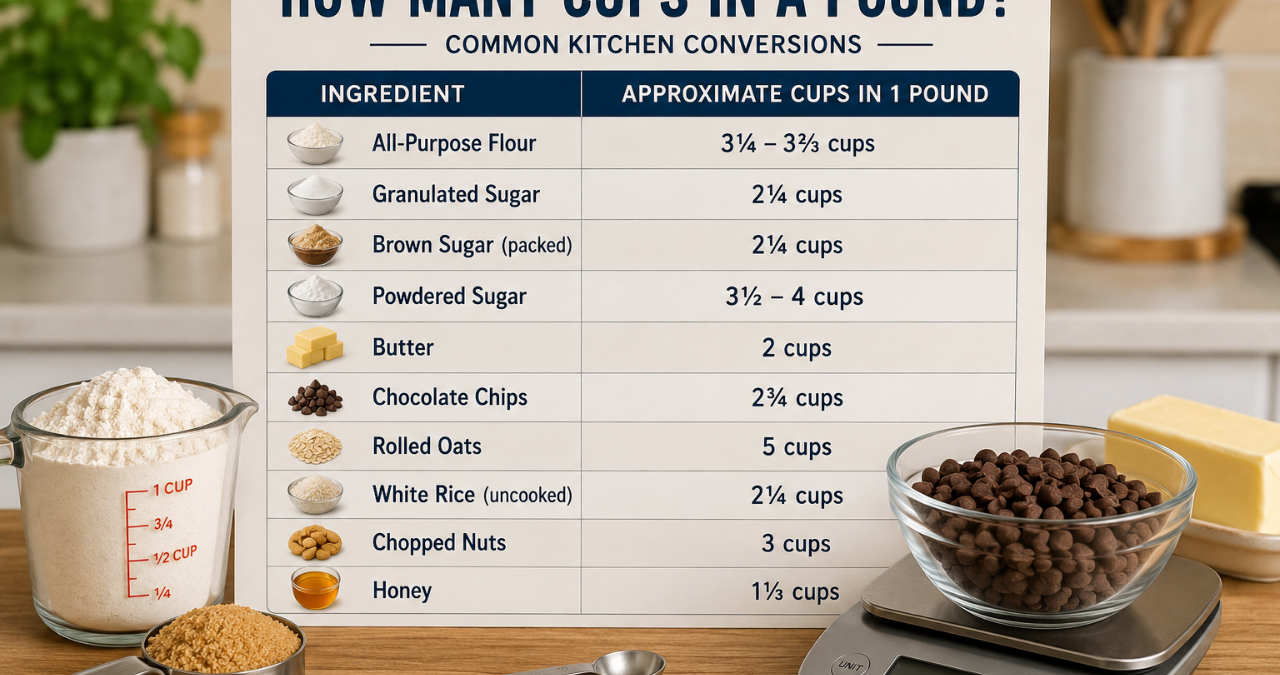
Here are some common approximate conversions:
| Ingredient | Approximate Cups in 1 Pound |
|---|---|
| All-purpose flour | 3¼–3⅔ cups |
| Granulated sugar | About 2¼ cups |
| Powdered sugar | About 3½–4 cups |
| Brown sugar, packed | About 2¼ cups |
| Butter | 2 cups |
| Shortening | About 2 cups |
| Rolled oats | About 5 cups |
| White rice, uncooked | About 2¼ cups |
| Chocolate chips | About 2¾ cups |
| Chopped nuts | About 3 cups |
| Honey | About 1⅓ cups |
| Peanut butter | About 1¾ cups |
| Cocoa powder | About 4 cups |
These numbers are estimates because brands, preparation methods, packing, and ingredient types can change the final measurement.
Why One Pound Doesn’t Always Equal the Same Number of Cups
How Many Cups in a Pound Imagine placing one pound of feathers and one pound of stones on a scale. Both weigh one pound, but they take up very different amounts of space.
Food works in much the same way.
The main reason is density.
Density describes how much matter is packed into a certain amount of space. A dense ingredient takes up less space, while a lighter ingredient takes up more space.
For example:
- Sugar is relatively dense, so one pound fits into fewer cups.
- Flour is lighter and more airy, so one pound takes up more cups.
- Honey is very dense, so one pound takes up fewer cups.
- Chopped lettuce is very light and bulky, so one pound could take up many cups.
In other words, you can’t simply say that every pound equals a fixed number of cups.
How Many Cups in a Pound of Flour?
How many cups in a pound Flour is one of the ingredients that causes the most confusion in baking.
A pound of all-purpose flour is usually around 3¼ to 3⅔ cups, depending on how the flour is measured.
A commonly used estimate is:
1 pound of all-purpose flour ≈ 3½ cups
However, the exact amount can vary.
Flour can become compact when stored or scooped directly from a bag. If you pack flour tightly into a cup, you’ll get more flour by weight than if you gently spoon it into the cup.
For better accuracy:
- Fluff the flour with a spoon.
- Spoon it into the measuring cup.
- Don’t press it down.
- Level the top with a straight edge.
For professional baking, a kitchen scale is even better.
Why Flour Measurement Matters
Baking is often more sensitive to measurement errors than ordinary cooking. Too much flour can make:
- Cookies dry
- Cakes heavy
- Bread dense
- Muffins tough
That’s why experienced bakers often prefer weight measurements.
How Many Cups in a Pound of Sugar?
Sugar is denser than flour, so one pound of sugar generally takes up fewer cups.
For granulated white sugar, one pound is approximately:
2¼ cups
This is an estimate, but it’s a useful kitchen conversion.
Powdered sugar is different because it contains very fine particles and may include a small amount of starch. One pound of powdered sugar can be approximately 3½ to 4 cups, depending on whether it’s sifted.
Brown sugar also needs special attention.
One pound of packed brown sugar is usually around 2¼ cups.
The word packed matters. When a recipe says packed brown sugar, press the sugar firmly into the measuring cup until it holds its shape when turned out.
How Many Cups in a Pound of Butter?
Butter is much easier to convert than many other ingredients.
In the United States:
1 pound of butter = 2 cups
This is because a standard pound of butter contains four standard sticks, and each stick equals half a cup.
So:
- 1 stick = ½ cup
- 2 sticks = 1 cup
- 4 sticks = 2 cups
- 1 pound = 2 cups
Butter is a great example of why knowing the specific ingredient makes conversion much easier.
If you’re baking cookies, cakes, frosting, or pastries, this conversion can save time when a recipe gives butter in pounds instead of cups.
How Many Cups in a Pound of Rice?
Rice is another ingredient where the answer depends on the type of rice.
For uncooked white rice, one pound is approximately 2¼ cups.
Different varieties may have slightly different weights and sizes. Long-grain rice, short-grain rice, jasmine rice, and basmati rice don’t always have exactly the same density.
It’s also important to distinguish between dry rice and cooked rice.
Cooking rice adds water, which increases its volume and weight. Therefore, one pound of cooked rice isn’t equal to the same number of cups as one pound of uncooked rice.
When following a recipe, check whether the measurement refers to rice before or after cooking.
How Many Cups in a Pound of Chocolate Chips?
Chocolate chips are often measured by cups in cookie recipes.
One pound of chocolate chips is approximately 2¾ cups, although the exact number can vary by chip size and brand.
For example, mini chocolate chips can pack differently than large chocolate chunks.
When making cookies, brownies, or desserts, a kitchen scale is the safest option if the recipe provides chocolate by weight.
Still, the cup estimate is useful when you’re working without a scale.
How Many Cups in a Pound of Nuts?
Nuts vary greatly in size, shape, and density.
One pound of chopped nuts may be around 3 cups, but this is only an approximation.
For example:
- Chopped walnuts
- Chopped pecans
- Almonds
- Cashews
- Peanuts
can all have different cup-to-pound conversions.
Whole nuts also take up more empty space between pieces than finely chopped nuts.
That’s why a pound of whole nuts and a pound of ground nuts won’t necessarily fill the same number of cups.
How Many Cups in a Pound of Liquid Ingredients?
Liquids are another interesting case.
Water has a relatively predictable relationship between volume and weight. In U.S. measurements, approximately:
1 pound of water ≈ 1.92 cups
This is close to two cups, but it isn’t exactly two cups.
Other liquids behave differently because their densities aren’t the same as water.
For example:
- Honey is heavier than water.
- Oil is lighter than water.
- Syrup is generally dense.
- Milk is slightly different from water.
So you shouldn’t assume that one pound of every liquid equals the same number of cups.
The Difference Between Weight and Volume
This is perhaps the most important concept to understand.
Weight
Weight tells you how heavy something is.
Common weight measurements include:
- Pounds
- Ounces
- Grams
- Kilograms
Volume
Volume tells you how much space something occupies.
Common volume measurements include:
- Cups
- Tablespoons
- Teaspoons
- Pints
- Quarts
- Liters
- Milliliters
A simple way to remember it is:
Pounds tell you how heavy. Cups tell you how much space.
Because different foods have different densities, converting between the two requires information about the specific ingredient.
Why a Kitchen Scale Is So Useful
If you cook regularly, a digital kitchen scale is one of the most useful tools you can own.
A scale can measure ingredients in:
- Grams
- Kilograms
- Ounces
- Pounds
Using a scale can improve accuracy, especially when baking.
For example, suppose a recipe calls for 500 grams of flour. Instead of guessing how many cups that might be, you can place a bowl on the scale, zero it, and add exactly 500 grams.
This method is:
- Faster
- More accurate
- Easier to repeat
- Less messy
- Helpful for baking
A scale can also reduce the number of measuring cups and spoons you need to wash. That’s a win-win.
Common Cup-to-Pound Conversion Chart
The following chart provides useful estimates for everyday cooking.
| Ingredient | 1 Pound Is Approximately |
|---|---|
| All-purpose flour | 3½ cups |
| Granulated sugar | 2¼ cups |
| Brown sugar, packed | 2¼ cups |
| Powdered sugar | 3½–4 cups |
| Butter | 2 cups |
| Honey | 1⅓ cups |
| Peanut butter | 1¾ cups |
| Rolled oats | 5 cups |
| Uncooked white rice | 2¼ cups |
| Chocolate chips | 2¾ cups |
| Chopped walnuts | 3 cups |
| Cocoa powder | 4 cups |
| Shortening | 2 cups |
| Water | About 1.9 cups |
Remember that these figures are approximate, not universal scientific constants for every brand and preparation style.
How to Convert Pounds to Cups
If you need to convert a particular ingredient, don’t simply divide or multiply by a fixed number.
Instead, find the ingredient’s weight per cup.
For example, suppose a particular flour weighs about 4.5 ounces per cup.
Since:
1 pound = 16 ounces
You can calculate:
16 ÷ 4.5 ≈ 3.56 cups
So one pound of that flour is approximately 3.56 cups.
This method is much more reliable than using one conversion for all ingredients.
How to Convert Cups to Pounds
The process works in reverse.
Suppose one cup of an ingredient weighs 8 ounces.
If you have 2 cups:
2 × 8 = 16 ounces
Since 16 ounces equal one pound:
2 cups = 1 pound
Again, the ingredient matters.
For example, two cups of butter equal one pound, but two cups of flour do not.
Measuring Dry Ingredients Correctly
When using cups for dry ingredients, your technique can affect the result.
The Spoon-and-Level Method
This is a good method for flour and similar ingredients.
Follow these steps:
- Stir or fluff the ingredient.
- Use a spoon to place it into the measuring cup.
- Fill the cup without pressing the ingredient down.
- Level the top with a knife or straight edge.
- Add the measured ingredient to your recipe.
This method helps prevent accidentally adding too much.
The Scoop Method
Some people dip the measuring cup directly into a container of flour.
This can pack the flour into the cup, resulting in a larger amount by weight.
It may seem like a small difference, but in baking, small differences can add up.
Measuring Brown Sugar Correctly
Brown sugar is usually measured differently.
When a recipe says 1 cup packed brown sugar, fill the cup and press the sugar firmly.
Continue adding and packing until the cup is full.
When turned out, the brown sugar should hold the shape of the cup.
If the recipe doesn’t specify “packed,” check the recipe source carefully because measurement conventions can vary.
Does Sifting Change the Number of Cups?
Yes, sifting can affect volume.
Sifting breaks up lumps and introduces more air into flour or powdered sugar. As a result, one cup of sifted flour can weigh less than one cup of unsifted, compacted flour.
There’s an important difference between:
- 1 cup flour, sifted
- 1 cup sifted flour
These phrases can mean different things in older or traditional recipes.
When accuracy matters, follow the recipe’s exact wording.
Common Mistakes When Converting Pounds to Cups
Even experienced cooks can make measurement mistakes.
Here are some common problems to avoid.
Assuming Every Pound Equals Two Cups
This is one of the biggest mistakes.
Butter happens to have a convenient conversion of two cups per pound, but many other foods don’t.
Confusing Fluid Ounces With Weight Ounces
A fluid ounce measures volume, while an ounce on a kitchen scale measures weight.
They’re related but not interchangeable in every situation.
Packing Flour Into a Cup
This can add too much flour to baked goods.
Ignoring the Ingredient Type
Different types of flour, rice, sugar, and nuts may have different densities.
Forgetting Whether Food Is Cooked
Cooked and uncooked ingredients can have very different volume and weight relationships.
How Many Cups in a Pound for Baking?
Baking is where this question becomes especially important.
Recipes for bread, cakes, cookies, pastries, and other baked foods often require careful measurements.
If a recipe lists ingredients by weight, it’s usually best to use a scale.
If it lists ingredients by cups, follow the recommended cup-measuring technique.
For the most consistent baking results:
- Use a digital kitchen scale when possible.
- Measure flour carefully.
- Don’t casually substitute weight for volume.
- Check whether ingredients are packed, sifted, chopped, or melted.
- Keep measurements consistent throughout the recipe.
This approach can make your baking more reliable.
Quick Reference for Everyday Cooking
If you’re in the middle of cooking and need a quick answer, these approximate figures can help:
- 1 pound butter = 2 cups
- 1 pound granulated sugar ≈ 2¼ cups
- 1 pound all-purpose flour ≈ 3½ cups
- 1 pound powdered sugar ≈ 3½–4 cups
- 1 pound brown sugar ≈ 2¼ cups packed
- 1 pound chocolate chips ≈ 2¾ cups
- 1 pound uncooked rice ≈ 2¼ cups
- 1 pound honey ≈ 1⅓ cups
- 1 pound rolled oats ≈ 5 cups
These are useful kitchen estimates, but a scale remains the best tool for exact results.
Tips for Getting Accurate Measurements
Good measurement isn’t difficult once you know a few tricks.
Use the Right Measuring Tool
Use dry measuring cups for dry ingredients and liquid measuring cups for liquids.
Read the Recipe Carefully
Look for words such as:
- Packed
- Sifted
- Chopped
- Melted
- Diced
- Cooked
- Uncooked
Each word can affect the final measurement.
Level Dry Ingredients
For flour and sugar, use a straight edge to remove excess from the top of the cup.
Use a Scale for Precision
If the recipe gives measurements in grams or ounces, use a kitchen scale whenever possible.
Don’t Guess When Accuracy Matters
A rough estimate is fine for some soups and sauces. However, baking often needs more precision.
Frequently Asked Questions
Is one pound always equal to two cups?
No. One pound does not always equal two cups. The conversion depends on the ingredient’s density. Butter is approximately two cups per pound, while flour is closer to 3½ cups per pound.
How many cups are in a pound of flour?
One pound of all-purpose flour is approximately 3¼ to 3⅔ cups. A common kitchen estimate is about 3½ cups.
How many cups are in a pound of sugar?
One pound of granulated sugar is approximately 2¼ cups.
How many cups are in a pound of butter?
One pound of butter equals 2 cups in standard U.S. measurements.
Can I use a cup to measure a pound?
You can estimate a pound using cups if you know the ingredient’s approximate density. However, a kitchen scale will provide a more accurate measurement.
Why are recipes sometimes written in pounds instead of cups?
Weight measurements are more precise and consistent. Professional bakers often use weight because ingredients can be packed differently when measured by volume.
Is a cup of flour the same weight as a cup of sugar?
No. A cup measures the same amount of space, but flour and sugar have different densities. Therefore, their weights are different.
Does chopped food change the cup-to-pound conversion?
Yes. Chopping changes how much empty space exists between pieces. Whole nuts, chopped nuts, and ground nuts may all have different volume measurements for the same weight.
A Simple Rule to Remember
If you remember only one thing from this guide, make it this:
A pound measures weight, while a cup measures volume.
Because foods have different densities, there isn’t one answer to how many cups in a pound.
Instead, ask:
“How many cups are in a pound of this specific ingredient?”
That small change in thinking makes kitchen conversions much easier.
Final Thoughts on How Many Cups in a Pound
Knowing how many cups in a pound can make everyday cooking and baking much less confusing. The most important point is that the answer depends on the ingredient. A pound of butter is about two cups, while a pound of flour is around 3½ cups, and a pound of powdered sugar may be closer to four cups.
For casual cooking, approximate conversion charts can be extremely helpful. When precision matters, especially in baking, a digital kitchen scale is the better choice.
Once you understand the difference between weight and volume, these conversions become straightforward. So, the next time a recipe leaves you wondering how many cups in a pound, don’t worry—you’ve got the tools to find the right answer and get cooking with confidence.